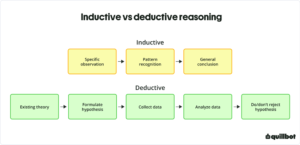
Inductive reasoning moves from specific observations to broad generalizations while deductive reasoning starts with a general premise and applies it to reach a conclusion.
If the premises are true, conclusions in deductive reasoning are certain. In inductive reasoning, any conclusions remain probabilistic (i.e., uncertain).
You can use either approach in different research designs, but it’s also possible to combine them.
TipWhether you’re building ideas with inductive reasoning or testing logic with deductive reasoning, Quillbot’s AI Chat helps you structure your thinking instantly. Start chatting and turn complex reasoning into clear answers.
Key takeaways
Inductive reasoning moves from specific observations to broader generalizations, while deductive reasoning starts with a general theory and applies it to specific cases to reach a conclusion.
Deductive conclusions are logically certain if the premises are true, whereas inductive conclusions are probabilistic and can always be revised with new evidence.
Inductive and deductive reasoning are often used together in research. Induction helps generate theories, and deduction tests them using data.
Semi-structured interviews balance structure and flexibility use a predefined set of topics or questions while allowing interviewers to ask follow-up questions and explore unexpected insights.
They are especially useful for exploratory research and recruitment. They are ideal for gathering rich, in-depth information.
Flexibility enables deeper conversations and more detailed responses, but it can also make interviews harder to compare and increase the risk of interviewer bias, making careful planning, neutrality, and structured analysis essential.
A semi-structured interview is a qualitative data collection method that combines predetermined questions with the flexibility to ask unplanned follow-up questions.
Semi-structured interviews are commonly used as an exploratory research method in social sciences, marketing, and other disciplines. They are typically qualitative, aiming to gather in-depth insights and perspectives from participants.
Beyond academic research, semi-structured interviews are also widely used in recruitment or in field studies where multiple interviewers work within the same theoretical framework. This approach enables researchers to explore the same core research questions while remaining flexible enough to pursue different themes, perspectives, or areas of interest as they emerge during the conversation.
NoteSemi-structured interviews combine elements of both structured and unstructured interviews. This data collection method follows a set of predefined questions or topics while allowing interviewers the flexibility to ask additional questions based on participants’ or candidates’ responses.
The three other common interview formats are:
Structured interviews: All questions are planned in advance, including their wording and order.
Unstructured interviews: There are no predetermined questions, allowing the conversation to develop naturally.
Focus group interviews: Questions are asked to a group of participants rather than to a single individual.
Data collection is the organized process of gathering observations, measurements, or other information. Whether the research is being carried out for business, government, or academic purposes, collecting data helps researchers obtain first-hand information and develop meaningful insights related to a specific research question or problem.
While the goals and techniques used in different fields may vary, the core principles of data collection are generally consistent. Before beginning the process, it is important to carefully consider several factors, including:
The main objective of the research
The kind of data that needs to be collected
The methods and procedures that will be used to gather, store, and analyze the data
By following a clear and structured approach, you can ensure the data collected is accurate, relevant, and useful for your research goals. The following four steps can help guide the process effectively.
TipUse Quillbot’s AI Chat to start brainstorming your data collection methods!
If you’ve spent any time on TikTok, Instagram Reels, or YouTube Shorts, you’ve probably come across the phrase “6-7” (pronounced “six-seven”). The phrase has become one of 2025’s most viral memes, but its meaning isn’t immediately clear.
The phrase “6-7” comes from the song “Doot Doot (6-7)” by Skrilla, released in early 2025. The line that sparked the trend appears in the chorus:
The way that switch brrt, I know he dyin’ (oh my, oh my God) 6-7, I just bipped right on the highway (bip, bip)
The exact meaning of “6-7” is intentionally vague. Skrilla hasn’t given a clear explanation, though some theories have emerged. Some speculate it might refer to 67th Street, possibly linked to the artist’s background or community. Others think it’s related to “10-67,” the police radio code used in some areas to notify of a death.
Despite these theories, most of the time “6-7” doesn’t hold a specific meaning. It functions more as a catchy, rhythmic phrase people repeat for humor or recognition, much like other viral slang phrases such as “skibidi” or “rizz.”
Inter-rater reliability is the degree of agreement or consistency between two or more raters evaluating the same phenomenon, behavior, or data.
In research, it plays a crucial role in ensuring that findings are objective, reproducible, and not dependent on a single observer’s judgment. Whether you’re analyzing questionnaire responses, coding interview transcripts, or assessing behavioral outcomes, strong inter-rater reliability boosts the credibility of your results.
The method to calculate inter-rater reliability depends on the type of data (e.g., nominal, ordinal, interval, or ratio) and the number of raters. The most common methods include Cohen’s kappa (for two raters), Fleiss’ kappa (for three or more raters), and the Intraclass Correlation Coefficient (for continuous data).
Example: Inter-rater reliability in qualitative researchA team of psychologists conducts qualitative research to examine workplace stress. They code open-ended interview responses to identify themes such as “workload pressure,” “lack of support,” and “burnout symptoms.”
During the thematic analysis, each researcher independently reads the transcripts and assigns codes to relevant passages. If the coders consistently label the same responses with the same themes, the study demonstrates high inter-rater reliability. This consistency ensures that the findings reflect real patterns in the participants’ experiences, rather than subjective interpretations or biases from individual researchers. This helps reduce observer bias.
TipIf you need to write a research report, thesis, or journal article, ensuring your grammar and clarity are top-notch is just as important as strong research methods. Use our Grammar Checker to catch errors and make your writing professional and polished.
Example: Countries that start with Z in a sentenceZambia and Zimbabwe are neighboring countries in southern Africa, known for their stunning landscapes and the famous Victoria Falls.
English only has one country that starts with W, which is Wales. There are also a few territories that start with “W,” such as “Western Sahara” and “Wallis and Futuna.”
Example: Countries that start with V in a sentenceVanuatu is known for its stunning islands, Vietnam for its delicious cuisine, and Venezuela for its breathtaking natural landscapes.