
Inductive vs Deductive Reasoning | Examples & Steps
Inductive reasoning moves from specific observations to broad generalizations while deductive reasoning starts with a general premise and applies it to reach a conclusion.
If the premises are true, conclusions in deductive reasoning are certain. In inductive reasoning, any conclusions remain probabilistic (i.e., uncertain).
You can use either approach in different research designs, but it’s also possible to combine them.
Key takeaways
- Inductive reasoning moves from specific observations to broader generalizations, while deductive reasoning starts with a general theory and applies it to specific cases to reach a conclusion.
- Deductive conclusions are logically certain if the premises are true, whereas inductive conclusions are probabilistic and can always be revised with new evidence.
- Inductive and deductive reasoning are often used together in research. Induction helps generate theories, and deduction tests them using data.
What is an example of inductive reasoning?
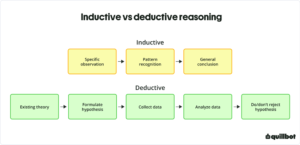
Inductive reasoning or research is used when the topic is new or understudied. Often, there’s no theory or hypothesis to test yet. There are three stages for the inductive approach:
- Observation
- The battery on my phone lasts longer when I reduce screen brightness.
- Three restaurants in the city are crowded on Friday nights.
- I invited two candidates with tailored cover letters to an interview.
- Looking for patterns
- Lower brightness consistently increases battery life.
- Most restaurants I’ve visited are crowded on Friday nights.
- All candidates I invited to an interview had tailored cover letters.
- Developing a theory or general (preliminary) conclusion
- Reducing screen brightness helps preserve battery life.
- Restaurants in this city tend to be busy on Friday nights.
- Tailored cover letters are generally more successful than generic ones.
Limitations of inductive reasoning
The biggest limitation of inductive reasoning is that any conclusions drawn on the basis of this method can’t be fully proven. You can only invalidate them.
However, you can never prove that the 1,001st successful candidate will also have quantified achievements on their resume. They might be hired for other reasons, such as exceptional experience, a strong portfolio, or a highly specialized skill set.
Even so, the larger the dataset, the more confidence you can have that including measurable achievements tends to improve a resume’s effectiveness.
What is an example of deductive reasoning?
In deductive research, you start with a theory as a result of inductive research. The goal is to test this theory. This means that you can’t conduct deductive research if there is no existing theory.
Deductive reasoning consists of four stages:
- Choose an existing theory and formulate a problem statement
- Students who attend lectures regularly achieve higher grades.
- Exercise improves cardiovascular health.
- Resumes that include relevant hard skills are more likely to result in interview invitations.
- Create a falsifiable hypothesis, based on existing literature
- If a student attends at least 90% of lectures, then they will receive a higher final grade than students who attend less often.
- If adults exercise at least 150 minutes per week, then they will have lower resting heart rates.
- If a resume includes the hard skills listed in the job description, then it will receive more interview invitations than resumes that do not include those skills.
- Collect data to test this hypothesis
- Record attendance and grades for 200 students.
- Measure exercise habits and resting heart rates of 500 adults.
- Compare 500 resumes that explicitly list relevant hard skills with 500 similar resumes that do not. Track interview invitation rates.
- Analyze the data and test the hypothesis
- 70% of high-attendance students received lower grades than low-attendance students.
- Regular exercisers had significantly lower resting heart rates.
- Resumes with relevant hard skills received interview invitations 40% of the time, while resumes without them received invitations 18% of the time.
- Determine whether you can reject the null hypothesis
- Reject the hypothesis.
- Support the hypothesis.
- Support the hypothesis.
Limitations of deductive reasoning
The conclusion of a deductive approach can only be true if all premises the conclusion relies on are true.
- Premise 1: All nurses who have ICU certification are qualified for ICU roles.
- Premise 2: Maria has ICU certification.
- Conclusion: Maria is qualified for an ICU role.
If both premises are true, the conclusion logically follows. However, the limitation is that deductive reasoning depends entirely on the accuracy of the premises.
In reality, Premise 1 is too absolute. Having an ICU certification does not automatically guarantee someone is qualified for every ICU role, because employers may also require:
- years of clinical experience
- soft skills (communication, teamwork under pressure)
- familiarity with specific hospital systems or equipment
So even though the reasoning is logically valid, the conclusion may be misleading if the premise is overly simplified or incorrect.
Combining inductive and deductive research
When a researcher wants to combine both approaches in a study, they generally start with an inductive research. This allows them to develop a theory for their theoretical framework.
This inductive study is then followed up with a deductive study to test the hypothesis or conclusion and to support or reject the conclusion.
Both approaches are at risk for different types of research bias, including confirmation bias and cognitive bias. You should always maintain the highest standard of reliability and validity in your research methods.
Frequently asked questions about inductive vs deductive reasoning
- Are hypothetical syllogisms inductive or deductive?
-
Hypothetical syllogisms express deductive reasoning, beginning with relatively general premises and inferring specific conclusions. All three major categories of syllogisms (hypothetical syllogisms, disjunctive syllogisms, and categorical syllogisms) are deductive.
In contrast, inductive reasoning begins with specific observations and infers relatively broad conclusions.
- Is analogical reasoning a form of inductive reasoning?
-
Analogical reasoning is sometimes considered a subcategory of inductive reasoning because it involves generalizing from specific instances to derive broader principles or patterns. However, some argue that analogical reasoning is distinct from induction because it involves drawing conclusions based on similarities between cases rather than generalizing from specific instances.
Along with abductive reasoning, they are forms of ampliative reasoning (in contrast to deductive reasoning).
- What is the difference between inductive and deductive reasoning?
-
Inductive reasoning and deductive reasoning are the two most prominent approaches to critical thinking and argumentation. Each plays a crucial role in reasoning and argumentation, but they serve different functions:
- Inductive reasoning relies on specific observations to form general conclusions. Example: “The sun has risen every day of my life; therefore, the sun will always rise every day.”
- Cannot prove a conclusion with absolute certainty
- Can result in informal logical fallacies (i.e., errors of content)
- Deductive reasoning (or formal reasoning) relies on general principles to form specific conclusions. Example: “All humans are mortal. Socrates was human. Therefore, Socrates was mortal.
- Can prove a conclusion with absolute certainty if the premises are true and the argument has a valid form
- Can result in formal logical fallacies (i.e., errors of form)
- Inductive reasoning relies on specific observations to form general conclusions. Example: “The sun has risen every day of my life; therefore, the sun will always rise every day.”
- Why is deductive reasoning stronger than inductive reasoning?
-
Deductive reasoning is considered stronger than inductive reasoning in a specific sense:
If a deductive argument’s premises are factually correct, and its structure is valid, then its conclusion is guaranteed to be true.
An inductive argument, in contrast, can only suggest the strong likelihood of its conclusion
Other interesting articles
If you want to know more about colors, letters, or the meaning of emojis, make sure to check out some of our other articles with explanations and examples.