Published on
June 9, 2024
by
Julia Merkus, MA.
Revised on
November 26, 2025
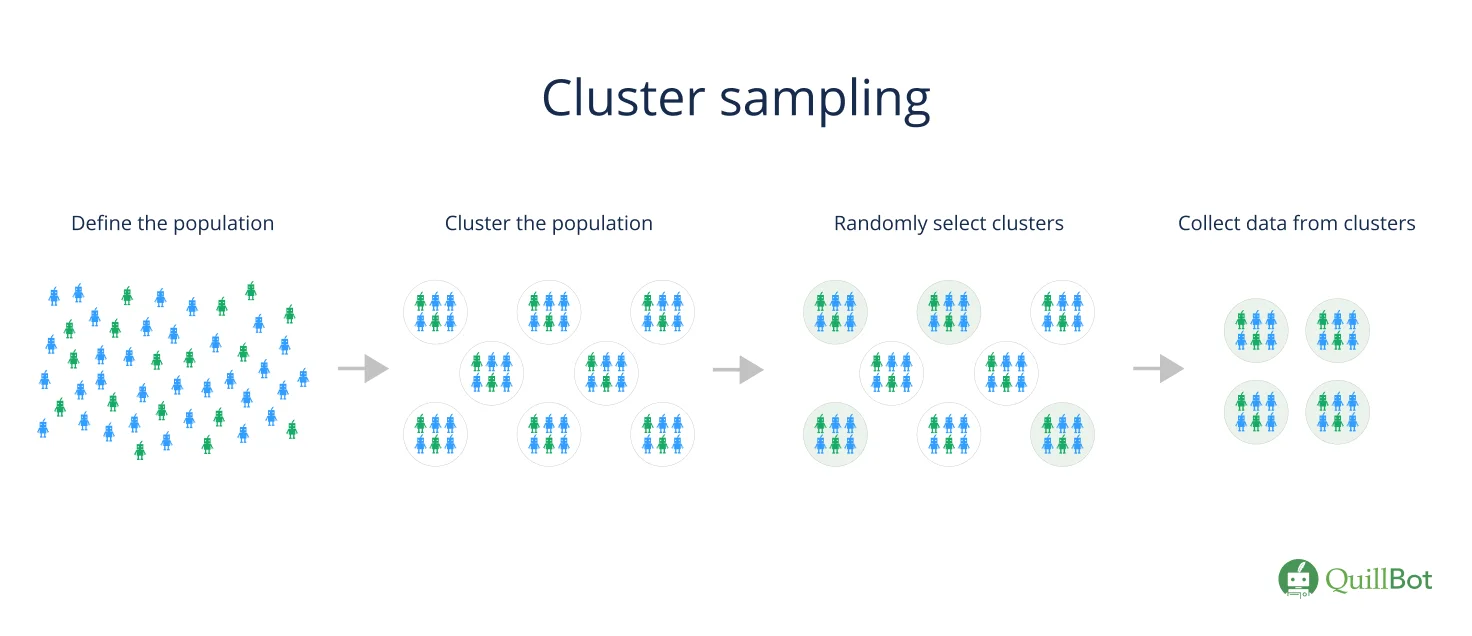
Cluster sampling is a probability sampling method where researchers divide a population into smaller groups called clusters. They then form a sample by randomly selecting clusters.
Cluster sampling is commonly used to study large populations, especially those with a wide geographic distribution. Researchers use existing groups or units (such as schools or towns) as their clusters.
Published on
June 9, 2024
by
Julia Merkus, MA.
Revised on
November 26, 2025
Stratified sampling is a probability sampling method where researchers divide a population into homogeneous subpopulations (strata) based on specific characteristics, such as gender, age, or socioeconomic status. Every member of the population should be in precisely one stratum.
Another sample is then drawn for each stratum using a different random sampling method (e.g., cluster sampling). This way, researchers can estimate statistics (e.g., averages) for each subpopulation.
Stratified sampling is used when the characteristics of a population vary and researchers need to make sure that the sample is representative of the entire population. This sampling method ensures high external validity and generalizability and minimizes the risk of some research biases.
Stratified sampling example A university wants to survey students about their satisfaction with campus facilities. The student population is diverse, including undergraduates, graduates, and doctoral students from various departments.
To ensure all groups are represented, the university decides to use stratified sampling based on academic level and department. They use a disproportionate sample to ensure the sample size of each subgroup is large enough to draw statistical conclusions.
Published on
June 9, 2024
by
Julia Merkus, MA.
Revised on
November 26, 2025
In simple random sampling, every member of the population has an equal probability of being chosen for the sample.
This probability sampling method is the easiest to execute because it requires minimal prior knowledge about the population and it involves only one random selection.
The use of randomization ensures that the sample is representative of the population, with a reduced risk of biases such as sampling bias and selection bias. Additionally, the sample’s internal and external validity are likely to be high.
Simple random sampling exampleA university wants to conduct a survey to understand the opinions of its students about a new campus recreation center. The university has a population of 10,000 students. To conduct the survey, the researcher decides to use simple random sampling.
The researcher obtains a list of all 10,000 students. They use a random number generator to select a random sample of 500 students from the list. The random number generator assigns a unique number to each student in the list and then selects 500 numbers at random.
Every student has an equal chance of ending up in the sample.
Published on
June 9, 2024
by
Julia Merkus, MA.
Revised on
November 26, 2025
Action research is a research method that combines investigation and intervention to solve a problem. Because of its interactive nature, action research is commonly used in the social sciences, particularly in educational contexts.
Educators frequently use this method as a means of structured inquiry, emphasizing reflective practice and combining theoretical knowledge and practical application.
The term “action research” was first introduced in 1944 by Kurt Lewin, a renowned MIT professor. Due to its cyclical nature, action research is also referred to as the action cycle, action model, or cycle of inquiry.
TipA generative AI tool, like AI Chat, can be helpful for brainstorming action research ideas and planning your research process.