
🇳🇮 Flag of Nicaragua | Facts, Meaning, Colors & History
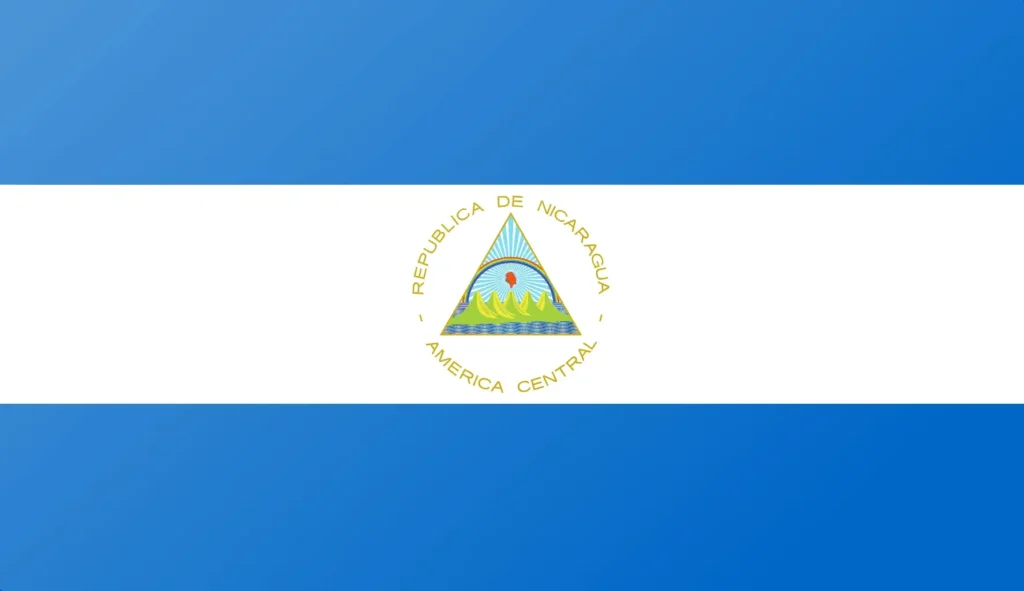
The flag of Nicaragua consists of two blue stripes, one white stripe, and a national coat of arms with text that says “Republica de Nicaragua, America Central.” It was first adopted in 1908 but wasn’t made official until 1971. It’s similar to the flags of several other Central American countries, particularly El Salvador.
To learn more about Nicaragua’s flag or another world flag, ask Quillbot’s AI Chat. You can also ask AI Chat for lists or types of flags, such as “flags of the world that include a coat of arms.”
Key takeaways
- The flag of Nicaragua features two blue stripes, a white stripe, and a detailed coat of arms that symbolizes the country’s geography, history, and values, including peace, liberty, and justice.
- Its modern design dates to 1908 and was officially standardized in 1971, but its roots trace back to the blue-white-blue flag of the former Federal Republic of Central America.
- Nicaragua’s flag closely resembles those of other Central American countries, especially El Salvador, because they share a common historical origin, though each has distinct symbols and proportions.
- The flag also stands out for its unique features, including the only sovereign-state flag with a literal rainbow and one of the few national flags to include the color purple.
Table of contents
- Quick facts about the flag of Nicaragua
- What does the flag of Nicaragua look like?
- What does the flag of Nicaragua symbolize?
- History of the Nicaraguan Flag
- Why are the flags of Nicaragua and El Salvador so similar?
- Fun facts about the Nicaraguan flag
- Frequently asked questions about the flag of Nicaragua
Quick facts about the flag of Nicaragua
Below are some key facts about the Nicaraguan flag in case you’re looking for a quick summary.
Quick facts about the flag of Nicaragua
| Feature | Details |
| Official name | Flag of the Republic of Nicaragua |
| Use | National flag and ensign (maritime flag) |
| Adopted | September 4, 1908 (made official on August 27, 1971) |
| Proportion | 1:2 |
| Colors | Blue and white with a multicolored coat of arms |
| Coat of arms | Features a triangle, five volcanoes, a rainbow, a Phrygian cap, and rays of the sun |
| Inspired by | The flag of the former Federal Republic of Central America, reflecting Nicaragua’s shared regional history |
What does the flag of Nicaragua look like?
The Nicaraguan flag consists of three stripes: two azure-blue stripes, at the top and the bottom, and one white stripe in the middle. In the center of the white stripe sits the country’s national coat of arms. Its proportion is 1:2, meaning its length is twice its height.
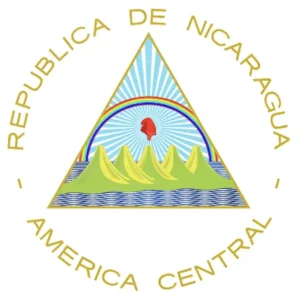
The Nicaraguan coat of arms shows a triangle, inside which five volcanoes sit in the middle of a blue sea. In the sky over the volcanoes there is a rainbow, sunrays, and a Phrygian cap. The Spanish text “Republica de Nicaragua, American Central” circles the triangle. In English, this text translates as “Republic of Nicaragua, Central America.”
Colors of the Nicaraguan flag
Below you can find the color codes for the colors of the flag of Nicaragua in various color formats for both digital and print.
Colors of the flag of Nicaragua
| Element | Color | Pantone (paper) | HEX | CMYK | RGB |
| Stripes | Azure | 281 C | #00205B | 100, 65, 0, 64 | 0, 32, 92 |
| White | Safe | #FFFFFF | 0, 0, 0, 0 | 255, 255, 255 | |
| Coat of arms | Gold | 125 C | #B58500 | 0, 27, 100, 29 | 181, 132, 0 |
| Sky blue | 292 C | #69B3E7 | 55, 23, 0, 9 | 105, 179, 231 | |
| Yellow | 109 U | #FFC700 | 0, 22, 100, 0 | 255, 199, 0 | |
| Green | 355 C | #009639 | 100, 0, 62, 41 | 0, 150, 57 | |
| Pastel blue | 277 C | #ABCAE9 | 27, 13, 0, 9 | 169, 202, 232 | |
| Black | Black | #000000 | 0, 0, 0, 100 | 0, 0, 0 |
For example, the blue of the Nicaraguan flag is referred to by various names, including “azure,” “cobalt,” or “dark blue,” and the light blue tones used in the coat of arms may also be listed with various names.
What does the flag of Nicaragua symbolize?
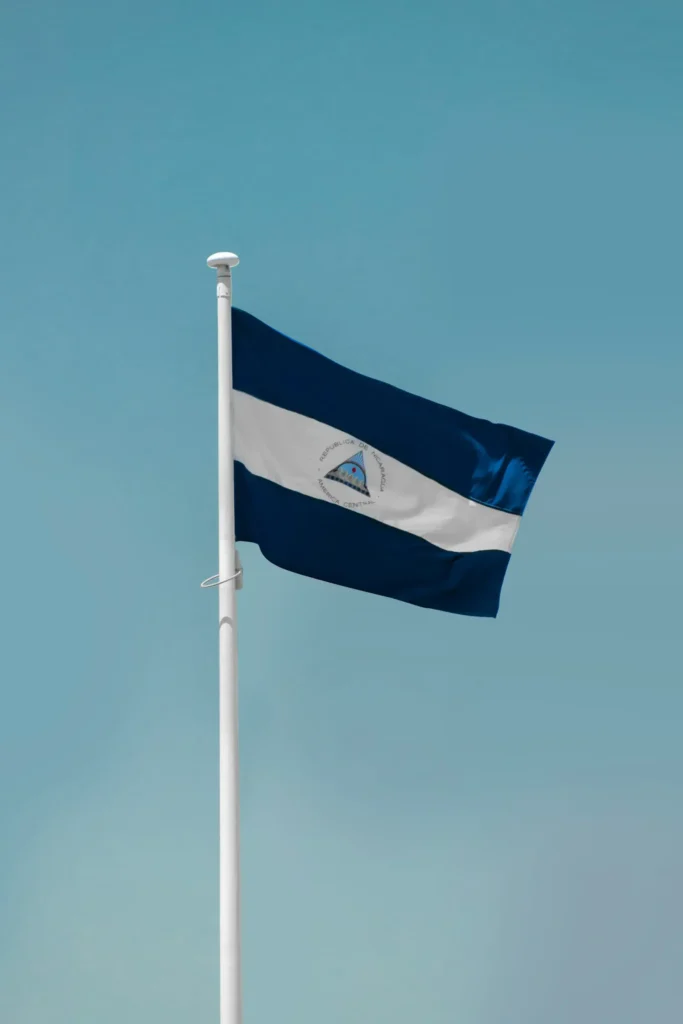
The flag of Nicaragua symbolizes the nations’ geography, values, and shared history with other countries of Central America. Each element of the flag has a specific meaning.
The flag’s two blue stripes represent the bodies of water that surround Nicaragua: the Pacific Ocean to the west and the Caribbean Sea to the east. Blue often symbolizes loyalty, justice, and tranquility. The white stripe represents peace and purity, and its position between the blue stripes evokes the country’s hope for harmony among its own people and with its neighbors.
The coat of arms represents various aspects of Nicaragua’s history, culture, and ideals:
- The triangle symbolizes equality and a commitment to justice.
- The five volcanoes represent the five original member states of the former Federal Republic of Central America (Nicaragua, Costa Rica, El Salvador, Guatemala, and Honduras).
- The Phrygian cap embodies liberty and freedom.
- The rainbow and sunrays signify peace and a bright future.
History of the Nicaraguan Flag
The Nicaraguan flag has evolved over nearly two centuries while retaining its connection to the country’s Central American heritage. Here’s a very brief summary of the history of the flag(s) of Nicaragua:
- 1821: Nicaragua and the rest of Central America declared independence from Spain.
- 1823: Nicaragua joined the Federal Republic of Central America, which adopted a blue-white-blue flag inspired by Argentina.
- 1841: The Federal Republic of Central America dissolved. Nicaragua became fully independent but continued using variations of the federation’s flag.
- 1854: Nicaragua adopted a new yellow-white-red tricolor. Political instability and civil conflict led to several flag changes in the following years.
- 1908: Nicaragua readopted the blue-white-blue design of the former federation, adding a modified national coat of arms. This became the country’s current national flag.
- 1971: A law officially standardized the flag’s design, including its colors, proportions, and coat of arms.
- 1979–1990: During the Sandinista government, the movement’s red-and-black flag was used alongside the national flag but was never adopted as the official national flag.
Why are the flags of Nicaragua and El Salvador so similar?
The flags of Nicaragua and El Salvador are so similar because both flags are based on the former flag of the Federal Republic of Central America. Both Nicaragua and El Salvador used to be part of the Federal Republic, which existed between 1823 and 1841.
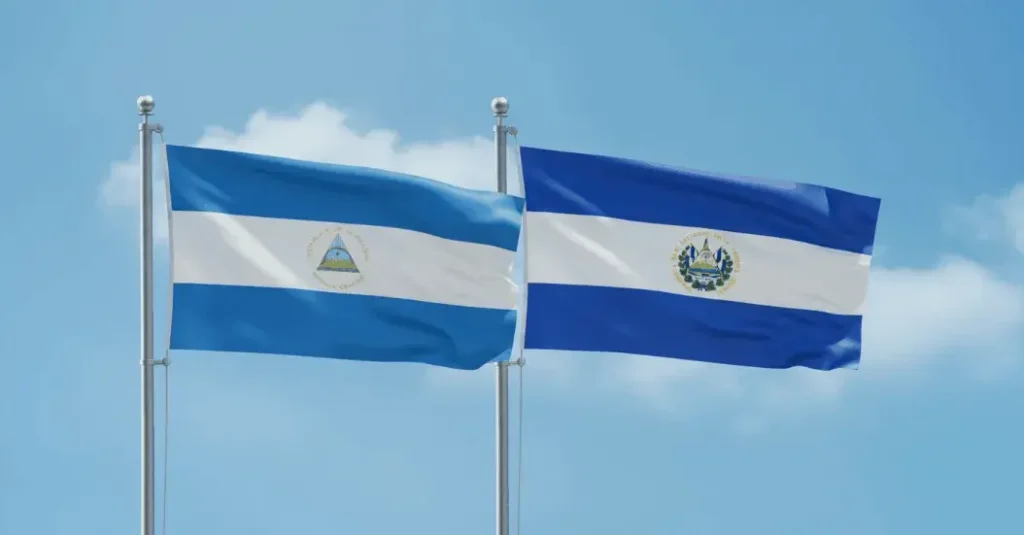
Both modern flags feature three horizontal blue and white stripes with a national coat of arms in the center. That said, there are a few key differences between them. El Salvador’s flag has a different proportion, different text surrounding its coat of arms, and no rainbow.
Fun facts about the Nicaraguan flag
Want some fun trivia facts about the flag of Nicaragua? Well, maybe you didn’t know that:
- It’s the only flag of a sovereign state to feature a literal rainbow.
- It’s one of three national flags that includes the color purple (the others are Dominica and El Salvador).
- It’s one of two national flags to show volcanoes (the other being El Salvador).
- Three country flags feature a Phrygian cap: Nicaragua, El Salvador, and Haiti.
- It was indirectly inspired by the flag of Argentina, which inspired the flag of the former Federal Republic of Central America.
- It’s similar to the flags of Honduras, Guatemala, and Costa Rica, all of which are also based on the flag of the former Federal Republic of Central America.
Frequently asked questions about the flag of Nicaragua
- What flag has purple?
-
Three country flags have purple: the flag of Nicaragua, the flag of El Salvador, and the flag of Dominica.
Another flag, the Wiphala, also has purple. The Wiphala is a co-official flag of Bolivia and represents the indigenous peoples of the Andes.
If you have more questions about flags, ask Quillbot’s AI Chat.
- When is Nicaragua Independence Day?
-
Nicaragua Independence Day is on September 15th.
This is because on September 15, 1821, Nicaragua and the other Central American countries proclaimed independence from Spain.
On September 15th in Nicaragua, it’s common to see the flag of Nicaragua, parades, marching bands, traditional dancing, music competitions, and a torch-passing ceremony.
To learn more about Nicaragua, ask Quillbot’s AI Chat.