
Flag of Bolivia | Meaning, History & Fun Facts
Bolivia is a small but mighty nation located in South America, with a proud, independent spirit and plurinational character. It is known for its sizable indigenous population and striking landscapes, which include the Amazon Rainforest, Andes Mountains, Atacama Desert, and Lake Titicaca.
In this guide, you’ll learn about the flag of Bolivia and the symbolism behind it. If you’re planning a trip to Bolivia, Quillbot’s Travel Itinerary Generator can help.
Key takeaways
- Learn the meaning, symbolism, and history behind Bolivia’s two official national flags: the red, yellow, and green tricolor and the Wiphala, which represents the country’s indigenous peoples and plurinational identity.
- Discover what each color and symbol represents, the history, and how the flags are used today.
- Explore downloadable, customizable Bolivia-themed graphics and phone backgrounds.
Flag of Bolivia meaning
When considering the flag of Bolivia, it’s important to note that two distinct flags are relevant here. There’s the official state flag and the Wiphala, which serves as a dual national flag. Below, you’ll learn about the meaning and significance of each.
State flag
The state flag of Bolivia is a tricolor that features horizontal stripes in red, yellow, and green with a coat of arms at the center.
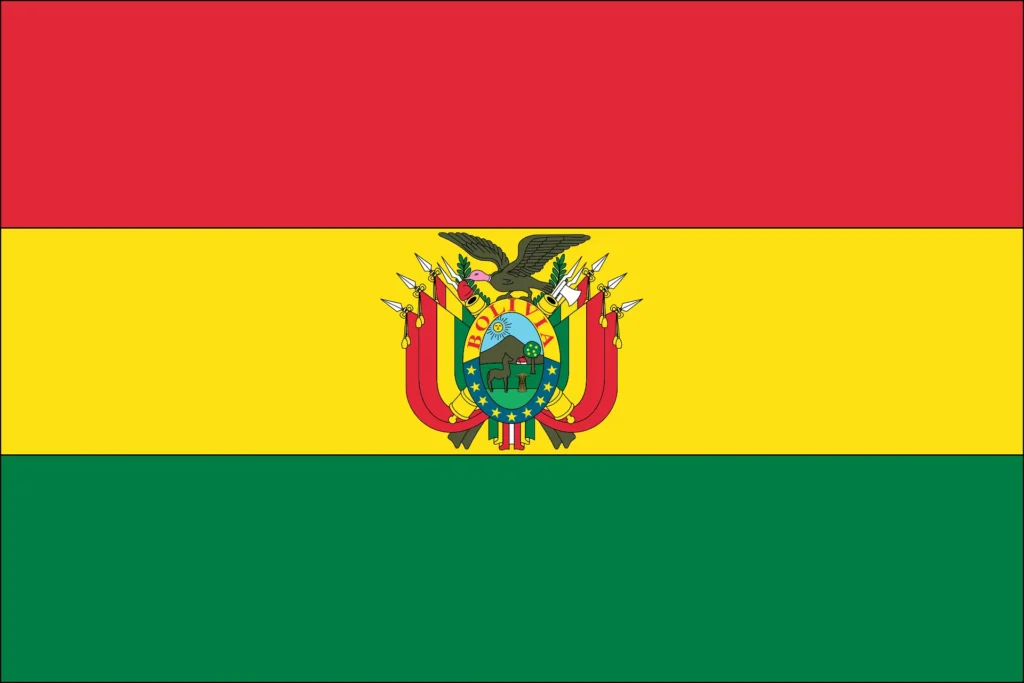
Here’s a breakdown of what the different visual components mean:
- Red: Represents the blood shed by those who have fought to secure and maintain Bolivia’s independence.
- Yellow: Signifies the nation’s wealth and natural resources, which include lithium, gas, and minerals.
- Green: Pays homage to the land, along with the hope carried by the Bolivian people.
- Coat of arms: Features a shield with the mountain Cerro Rico de Potosí, along with a llama, rising sun, and condor—all key emblems of the nation.
The civil flag of Bolivia, which is used outside of official government and military contexts, contains the same tricolor but without the coat of arms.
Wiphala flag
As of 2009, Bolivia’s revised constitution also recognizes the Wiphala as part of its plurinational character. This flag features a 7 x 7 square patchwork design made up of seven colors. It is a flag that represents the native peoples of the Andes, including the Aymara and Quechua.
It’s a symbol of solidarity across indigenous nations in the region, and is tied to their connection with the Earth.
- Red: The earth and the Andes
- Orange: Indigenous society and culture
- Yellow: Strength and energy
- White: Time and change
- Green: Wealth and natural resources
- Blue: The cosmos
- Violet: Andean governance and self-determination
Flag of Bolivia history
Bolivia gained independence from Spain in 1825. After using other variations, the current flag of Bolivia was adopted in 1851 during the presidency of Manuel Isidoro Belzu.
In 2004, then president Carlos Mesa established that the official flag with the coat of arms would be reserved for military and political contexts, while the tricolor without the coat of arms would be reserved for civic, patriotic, and general public use.
Under President Evo Morales in 2009, the Wiphala was added as the co-official flag under the revised constitution and in line with the nation’s stated plurinational character to represent the indigenous groups residing there.
Fun facts about Bolivia
Learn some additional facts about Bolivia’s demographics and geography.
- Lake Titicaca, which straddles the borders of Peru and Bolivia, is the largest lake on the continent and one of the largest in the world. It’s also the highest lake above sea level in the world.
- In addition to having two flags, Bolivia also has two capital cities: La Paz and Sucre.
- Up to 48% of Bolivia’s population has indigenous roots, which ranks it among the highest in Latin America. By extension, the country recognizes over 36 official native languages.
- Bolivia has many unique landscapes and wildlife including the famous salt flats, along with pink dolphins as well as flamingos.
Frequently asked questions about the flag of Bolivia
- Does Bolivia have two flags?
-
As of 2009, Bolivia has two official flags, which represent its plurinational character.
The state flag consists of horizontal red, yellow, and green stripes with a coat of arms at the center. It’s used in political and military contexts. A similar flag without the coat of arms is used for civil purposes such as celebrations and events.
In addition, the Wiphala flag is also recognized as an official flag. This flag features a checkered pattern with red, orange, yellow, white, green, blue, and violet squares. It represents the indigenous Andean peoples who reside in and around Bolivia.
Create custom Bolivia graphics using Quillbot’s free Background Generator.
- Which country’s flag has red, yellow, and green stripes?
-
There are several countries with red, yellow, and green stripes.
Countries with red, yellow, and green horizontal stripes include:
- Bolivia
- Ghana
- Ethiopia
Countries with red, yellow, and green vertical stripes include:
- Guinea
- Mali
- Cameroon
Translate messages and greetings into 50+ languages using Quillbot’s free Translate tool.
Other interesting articles
If you want to know more about colors, letters, or the meaning of emojis, make sure to check out some of our other articles with explanations and examples.