You can use AI responsibly when writing by treating it as a writing assistant rather than a replacement for your thinking. Use AI to brainstorm ideas, create outlines, or refine drafts, then add your own expertise and verify important information.
AI-generated drafts should always be reviewed for clarity, accuracy, and tone. Tools like Quillbot’s Paraphraser can help rewrite awkward passages, while the Grammar Checker can identify grammar, spelling, and readability issues. Human review remains an essential part of the writing process.
AI-generated content may contain patterns such as repetitive phrasing, generic examples, or predictable sentence structures.
Tools like Quillbot’s AI Detector can help identify text that may appear AI-generated, allowing you to review and refine your content before publishing. However, the goal should be to improve quality and authenticity rather than simply trying to avoid detection
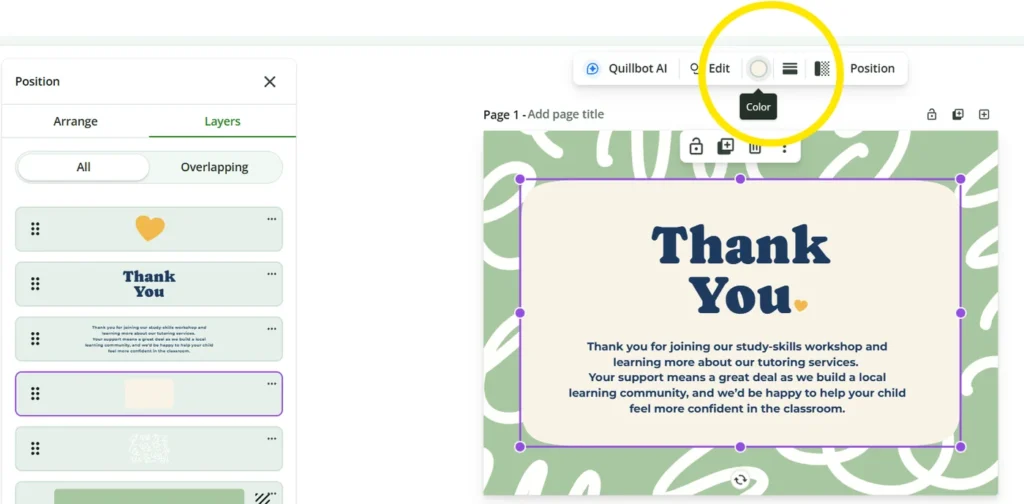
To change the color of an element in a thank you card template, try clicking on it to see if color options appear.
In Quillbot’s free online card templates, you can view all the elements in a design by clicking “Position,” which brings up the layer view. To change the color of an element, all you need to do is click on the element in the layer view and use the color options that appear in the menu above the design.
If you want to print the cards you make with thank you card templates, PDF is usually the best file format because it preserves your layout and design quality.
If you’re making a card for social media, then PNG is a good choice because it keeps text, graphics, and colors looking crisp on screen.
Select the “PDF Print” option in Quillbot’s card templates when you’re making cards that you want to print.
Several tools can support the editing process. Quillbot’s Humanize AI tool helps make AI-generated text sound more natural, the Paraphraser offers alternative ways to express ideas, and the Grammar Checker helps improve clarity and correctness before publication.
AI-generated content often includes repetitive phrasing, generic examples, overly formal language, and predictable structures. Using Quillbot’s Humanize AI tool can help reduce these patterns, while the Paraphraser can rewrite awkward or repetitive sentences to create more natural-sounding content.
To make AI writing sound more human, add personal experiences, use conversational language, vary sentence structure, and include specific examples. You can also use Quillbot’s Humanize AI tool to improve flow and naturalness, then refine your content with the Grammar Checker to ensure clarity and correctness.
The responsible way to avoid AI detection in academic writing is to ensure the work reflects genuine understanding and original thought. AI-generated essays often sound overly polished, repetitive, or generic.
Students can make their writing more authentic by:
Adding course-specific insights
Including personal analysis or interpretation
Using varied sentence structures
Revising AI-assisted drafts carefully
Citing sources properly
Educational institutions increasingly encourage responsible AI use rather than complete avoidance, making transparency and originality more important than simply lowering a detection score.